VIVO Pathophysiology
Mechanism of Action: Hormones with Intracellular Receptors
Receptors for steroid and thyroid hormones are located inside target cells, in the cytoplasm or nucleus, and function as ligand-dependent transcription factors. That is to say, the hormone-receptor complex binds to promoter regions of responsive genes and stimulate or sometimes inhibit transcription from those genes.
Thus, the mechanism of action of steroid hormones is to modulate gene expression in target cells. By selectively affecting transcription from a battery of genes, the concentration of those respective proteins are altered, which clearly can change the phenotype of the cell.
Structure of Intracellular Receptors
Steroid and thyroid hormone receptors are members of a large group ("superfamily") of transcription factors. In some cases, multiple forms of a given receptor are expressed in cells, adding to the complexity of the response. All of these receptors are composed of a single polypeptide chain that has, in the simplist analysis, three distinct domains:
- The amino-terminus: In most cases, this region is involved in activating or stimulating transcription by interacting with other components of the transcriptional machinery. The sequence is highly variable among different receptors.
- DNA binding domain: Amino acids in this region are responsible for binding of the receptor to specific sequences of DNA.
- The carboxy-terminus or ligand-binding domain: This is the region that binds hormone.
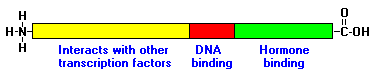
In addition to these three core domains, two other important regions of the receptor protein are a nuclear localization sequence, which targets the the protein to nucleus, and a dimerization domain, which is responsible for latching two receptors together in a form capable of binding DNA.
Hormone-Receptor Binding and Interactions with DNA
Being lipids, steroid hormones enter the cell by simple diffusion across the plasma membrane. Thyroid hormones enter the cell by facilitated diffusion. The receptors exist either in the cytoplasm or nucleus, which is where they meet the hormone. When hormone binds to receptor, a characteristic series of events occurs:
- Receptor activation is the term used to describe conformational changes in the receptor induced by binding hormone. The major consequence of activation is that the receptor becomes competent to bind DNA.
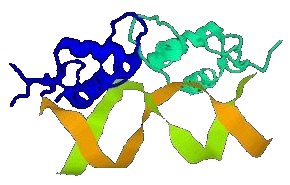
- Activated receptors bind to "hormone response elements", which are short specific sequences of DNA which are located in promoters of hormone-responsive genes. In most cases, hormone-receptor complexes bind DNA in pairs, as shown in the figure below.
- Transcription from those genes to which the receptor is bound is affected. Most commonly, receptor binding stimulates transcription. The hormone-receptor complex thus functions as a transcription factor.
 As might be expected, there are a number of variations on the themes described above, depending on the specific receptor in question. For example, in the absense of hormone, some intracellular receptors do bind their hormone response elements loosely and silence transcription, but, when complexed to hormone, become activated and strongly stimulate transcription. Some receptors bind DNA not with another of their kind, but with different intracellular receptor.
As a specific example, consider glucocorticoids, a type of steroid hormone that probably affects the physiology of all cells in the body. The image to the right depicts a pair of glucocorticoid receptors (blue and green on the top) bound to their DNA hormone response element (bottom). The two steroid hormones are not visible in this depiction.
The consensus sequence of the hormone response element in this case (called a glucocorticoid response element) is GGTACANNNTGTTCT, where N is any nucleotide.


Send comments to Richard.Bowen@colostate.edu